


Page 23 - Unleashed BMM 2019-2020
P. 23
the spinning of chips into yarn became costlier
       as GST was levied on the process. This lead to
       the shutting down of looms which were small
       and highly unorganized,” he explained.

       Transparency and Accountability
       The Shiv Shakti Textile Market is one of the
       oldest markets in the city. It along with the
       same  likes  once  used  to  boom  with  traders
       lining up for buying the shops in the markets.
       Now, the same markets has shops being closed
       down and vacant, but with no personnel to buy
       them.  The  small  traders  couldn’t  sustain
       themselves in the market. Due to which the
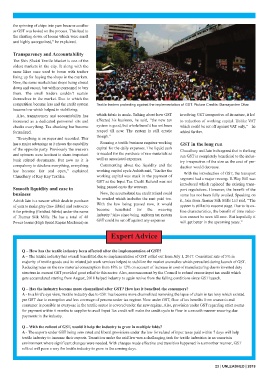
       competition became less and the credit system  Textile traders protesting against the implementation of GST. Picture Credits: Damayantee Dhar
       became low which helped in stabilizing.
        Also,  transparency  and  accountability  has  which fabric is made. Talking about how GST  involving GST irrespective of its nature, it led
       increased  as  a  dedicated  personnel  sits  and  affected  his  business,  he  said,  “the  new  tax  to reduction of working capital. Unlike VAT
       checks everything. Tax checking has become  system is good, but whole benefit has not been  which could be set off against VAT only,” – he
       formalized.                          reaped  till  now.  The  system  is  still  erratic  added further.
                                            though.”
        “Everything is on paper and recorded. This
       has a major advantage as it shows the capability  Running a textile business requires working  GST in the long run
       of the opposite party. Previously the weavers  capital for the daily expenses. The liquid cash  Choudhary and Jain both agreed that in the long
       and spinners were hesitant to share important  is needed for the purchase of raw materials as  run GST is completely beneficial to the indus-
       bank  related  documents.  But  now  as  it  is  well as associated expenses.
                                                                                 try irrespective of the size as the cost of pro-
       compulsory to disclose everything, everything  Commenting  about  the  liquidity  and  the
                                                                                 duction would decrease.
       has  become  fair  and  open,”  explained  working capital cycle Ashish said, “Earlier the
                                                                                   With the introduction of GST, the transport
       Chaudhary of Kay Kay Textiles.       working capital was stuck in the payment of
                                                                                 segment had a major revamp. E-Way Bill was
                                            GST as the Input Tax Credit Refund was not
                                                                                 introduced which replaced the existing trans-
       Smooth liquidity and ease in         being passed on to the weavers.      port regulations. However, the benefit of the
       business                               Now, the accumulated tax credit refund could  same has not been fully availed. Speaking on
                                            be availed which includes the rent paid too.
       Ashish Jain is a weaver which deals in purchase                           it, Jain from Jhumar Silk Mills Ltd said, “The
                                            With  the  law  being  passed  now,  it  would
       of yarn to make grey (raw fabric) and outsource                           system is still at its nascent stage. Due to its on-
                                            become   beneficial   for   the   weaving
       it for printing (finished fabric) under the name                          line characteristics, the benefit of time reduc-
                                            industry.“Also since being  uniform tax system
       of  Jhumar  Silk  Mills.  He  has  a  total  of  48                       tion cannot be seen till now. But hopefully it
                                            GST could be set off against any expenses
       Power looms (High Speed Rapier Machines) on                               will get better in the upcoming years.”
                                                  Expert Advice

           Q – How has the textile industry been affected after the implementation of GST?
           A – The textile industry has overall benefitted due to implementation of GST rolled out from July 1, 2017. Consistent rate of 5% in
           majority of textile goods and its related job work services helped to stabilize the market anomalies which prevailed during launch of GST.
           Reducing rates on the raw material consumption from 18% to 12% on account of increase in cost of manufacturing due to inverted duty
           structure in current GST provided great relief to this sector. Also, announcement by the Council to refund excess input tax credit which
           gets accumulated starting from August, 2018 helped industry to again revive from the falling conditions since GST launch.


           Q – Has the industry become more channelized after GST? How has it benefited the consumers?
           A - In a bird’s eye view, Textile Industry due to GST has become more channelized removing the lapse of chain in tax levy which existed
           pre GST due to exemption and less coverage of persons under tax regime. Now under GST, flow of tax benefits from source to end
           consumer is possible as everyone in the textile sector is covered under the new regime. Also, provision under GST regarding strict norms
           for payment within 6 months to supplier to avail Input Tax credit will make the credit cycle to flow in a smooth manner ensuring due
           payments in the industry.

           Q – With the rollout of GST, would it help the industry to grow in multiple folds?
           A - The exports under GST being zero rated and liberal provisions under the law for refund of input taxes paid within 7 days will help
           textile industry to increase their exports. Transition under the said law was a challenging task for textile industries in an uncertain
           environment where significant changes were needed. With changes made effective and transition happened in a smoother manner, GST
           rollout will pave a way for textile industry to grow in the coming days.


                                                                                                 23 | UNLEASHED | 2019

